Second Chances
Some people collect sneakers or limited-edition tech. I collect houses that need a second chance.
My obsession started in the 90s on Capitol Hill, when I bought my first house and—armed with youthful optimism and a laughably thin budget—set out to undo a truly tragic 1980s renovation. I could only afford cosmetic fixes back then, but it was enough to catch the restoration bug: the thrill of peeling back mistakes, honoring a home’s era, and making something old shine again. I learned the value of good bones… and the high cost of bad bathrooms.
Sydney: Creativity with Constraints
Sydney came next. On the Balmain peninsula, I bought a bungalow that had already pushed my budget to its absolute limit—so the renovation funds were… let’s call it aspirational. That constraint forced real creativity.
I learned how to fix bad cosmetics in tight spaces, make small rooms feel intentional rather than improvised, and stretch every dollar without sacrificing design.
Of course, I wanted to do more—reinforce the bouncy first floor, relocate the staircase, really reshape the space—but every project needs a ceiling or you risk renovating yourself into a financial black hole. When I finally sold the house, the profit was modest, but the relief was enormous. And honestly, that might be the best lesson I learned: beautiful transformations only count if they’re also smart.
“A building is alive, like a man, and its spirit is the spirit of its makers”
— Frank Lloyd Wright
London & Africa: A New Design Language
Living in London taught me restraint—how minimalism, proportion, and intentional simplicity can make even compact spaces feel considered. Time spent in Africa added the counterpoint: architecture that embraces light, landscape, and seamless connections between indoors and out. Together, those experiences reshaped how I think about space—not as rooms, but as relationships between people, light, and nature.
Scaling Up Stateside
Back in the U.S., the next project marked a turning point—the moment I graduated from cosmetic updates to full-scale reinvention.
I tackled a complete primary suite overhaul, replaced every inch of flooring (including a modern take on a classic Washington standby: black-and-white checkerboard, reimagined in oversized porcelain), and even built a dedicated movie theater. That was the project that taught me restoration is only half the story—the other half is reimagining how a home functions for modern life.
Then came a new-build industrial townhouse in Downtown Crown. Watching a house materialize from dirt to drywall is like seeing its DNA assemble in real time. You learn every system. You appreciate craftsmanship. And you develop an allergy to builder-grade finishes even the biggest budgets can’t fully fix.
The Latest Project
Which brings me here: my newest project, and the heart of Restore & Reimagine.
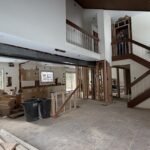
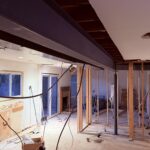
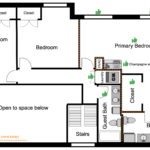
My husband and I are restoring a mid-century modern home—rare in Washington’s colonial-heavy suburbs—and bringing it back to life with respect, intention, and a fresh perspective. Everything I’ve learned comes into play: how to honor a home’s period without turning it into a time capsule straight out of Stranger Things.
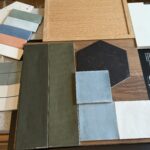
Our goal is to enhance its connection to nature, return to materials and a color palette true to the era, and modernize it for today’s living without erasing what made it special.
This is the journey. The decisions. The discoveries. The wins and the inevitable “why is this wall shaped like that?” moments… maybe because it’s covering up a leaky furnace exhaust.
And you get to watch it unfold.
Behind the Build: What’s New
-
Chapter 15 – Final Finishes Before Floors
Final finishes come together as dirty work wraps up, custom details land, and the home prepares for flooring
-
Chapter 14 – Fixer to Fabulous in Florida
Bricks, demolition, and bad ideas with a Volkswagen: how we transformed a Fort Lauderdale fixer-upper into a beach house getaway
-
Chapter 13 – The Shape of Things to Come
The renovation takes shape: oak cabinetry, geometric fireplace, and spa-like spaces reveal the design vision behind our mid-century home
-
Chapter 12 – New Construction in Crown
From impulse purchase to intentional design: lessons learned elevating new construction from builder grade to bespoke in Downtown Crown
-
Chapter 11 – The Last Cut Was The Deepest
Chapter 11 details the final structural fixes and design choices in our Bethesda mid-century renovation before drywall seals it all in
-
Chapter 10 – Mastering Minimalism
London Calling to the Faraway Towns I was in the middle of Sunday brunch at the Daily Grill on K Street—a monthly ritual with my friend group—when my Nokia cell phone, the one featured in The Matrix, rang. Loudly. Yes, it … Continued
-
Chapter 9 – One Hole After Another
Living the layout before drywall—walking routines, testing decisions, and making last-chance adjustments before everything becomes permanent
-
Chapter 8 – Beyond the Surface in Bethesda
Back in the U.S., the next project marked a turning point—the moment I moved from cosmetic updates to full-scale reinvention
-
Chapter 7 – Framing the Future
Chapter 7 pivots from planning to construction—steel beams, framing deadlines, lighting logic, and final decisions shaping the house
-
Chapter 6 – Solving the Second Floor
Chapter 6 redesigns the problematic second floor—eliminating wasted hallways, expanding the primary, and restoring light, flow, and function
-
Chapter 5 – Reframing Sydney
A move to Sydney, a frenzied auction, and a sandstone cottage renovation in Balmain—where tight budgets forced clarity, restraint, and better design.
-
Chapter 4 – Fixing First Floor Flow
A reimagined first floor that opens the kitchen, improves flow, and updates a mid-century home for modern living
-
Chapter 3 – Capital Hill
My Capitol Hill home taught me hard lessons about space, light, and how poorly planned remodels harm a house over time
-
Chapter 2 – Design with Intention
A personal look at mid-century modern design, from postwar necessity to color, materials, and how intentional rooms shape everyday living.
-
Chapter 1 – Our First Mid-century
Follow our mid-century modern renovation as we restore original intent, rethink the floor plan, and apply lessons learned from the past