Under the English Channel
Only a few days after returning from Florence, I was already heading back to continental Europe, this time to meet up with a coworker in Brussels.
Florence had been about encountering Europe through its history. Brussels would turn out to be about something slightly different: beginning to understand what it meant to actually live here now.
I had been working closely with Patrick in London on the JPMorgan Chase merger, and at some point he suggested that instead of spending I should come visit him and his wife. He spoke about her frequently so I felt I already knew her and, honestly, I don’t need to be asked twice to explore another new international destination.
I packed for the weekend and headed for Waterloo Station.
This was my first trip on the Eurostar, and I was disproportionately excited about one particular part of it: going through the Channel Tunnel. There was something equally historic and futuristic about boarding a train in London, disappearing beneath the English Channel, and emerging in continental Europe without setting foot in an airport.
We dined as the English countryside slipped past the windows, sampled English wine—which answered both whether England made wine and, based on that particular bottle, whether it should—and eventually watched the scenery turn into the rolling countryside of northern France.
What struck me was how easy the entire thing was. International travel had always meant airports, planes, checkpoints, and a fair amount of lost time en route to airports. Here I was eating dinner on a train while traveling underneath the sea to another country. It was nice, easy. How visiting your global neighbors should feel.
Looking Down on Brussels
Patrick had arranged our hotel and somehow secured a the top floor room with a spectacular balcony and view over the city’s main square. Even late at night, from the hotel balcony, Brussels was alive and rather theatrical. Old buildings wrapped tightly around streets and squares filled with cafés, pedestrians and umbrellas. There seemed to be very little separation between where people worked, ate, drank, lived and wandered. The city wasn’t something people drove through on their way somewhere else. The city itself was where life happened.
We spent our first evening exploring some of those cafés and bars before getting a little sleep. The next morning Patrick called and announced that our actual education in Brussels was about to begin.
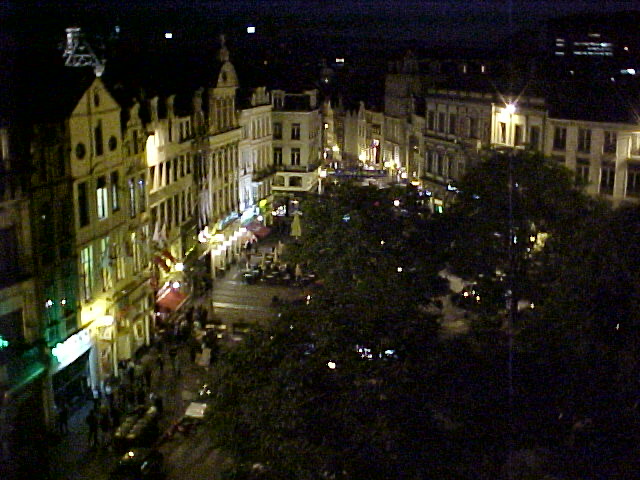 Brussels from our hotel at night
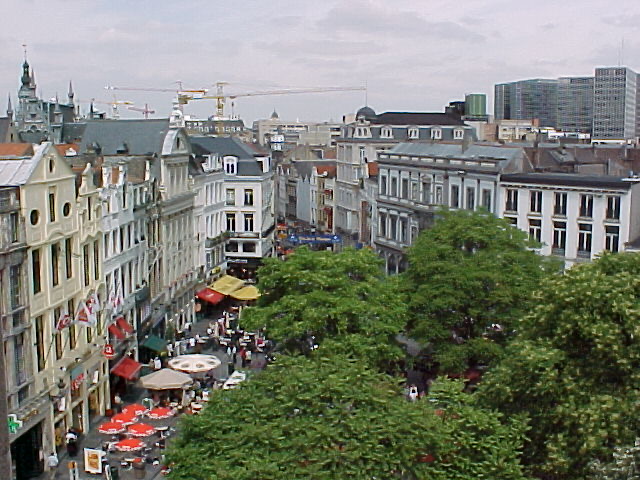 The same view the following morning
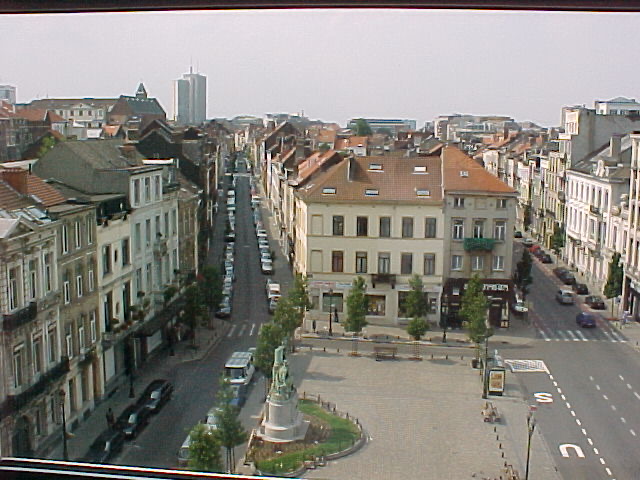 The view from Patrick’s flat
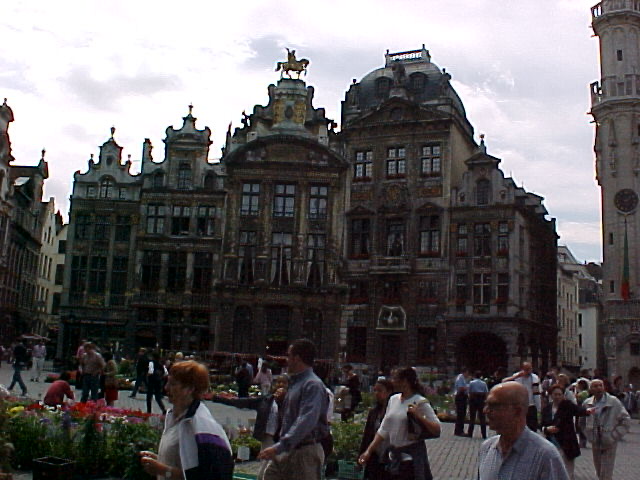 The Beer and Boatsman guilds
The Grand Place
We met Patrick in the Grand Place, and it was immediately obvious why he had chosen it as our starting point. The square is almost absurdly ornate. Every direction presents another façade covered in stone carvings, statues, gilding, towers and increasingly elaborate rooflines.
These buildings weren’t simply decorative.
The Grand Place developed as Brussels’ commercial center, and from the late Middle Ages onward many of the city’s trade guilds established themselves around it. Brewers, boatmen, bakers, carpenters and other trades formed organizations that regulated their professions, trained apprentices and established standards. They weren’t universities in the modern sense, but they provided an early system of higher education for professional education and accreditation of skills that were, and in fact still are, in high demand.
Patrick’s explanation was considerably more memorable.
”The Brewers were the first guild, followed almost immediately by the Boatmen,” he explained
Naturally.
“Once we (Belgians) figured out how to produce beer in quantity, somebody had to ship it,” he finished with a laugh.
I have no idea whether the chronology survives historic scrutiny, but it remains my preferred explanation of the advancement of Belgian and European commerce.
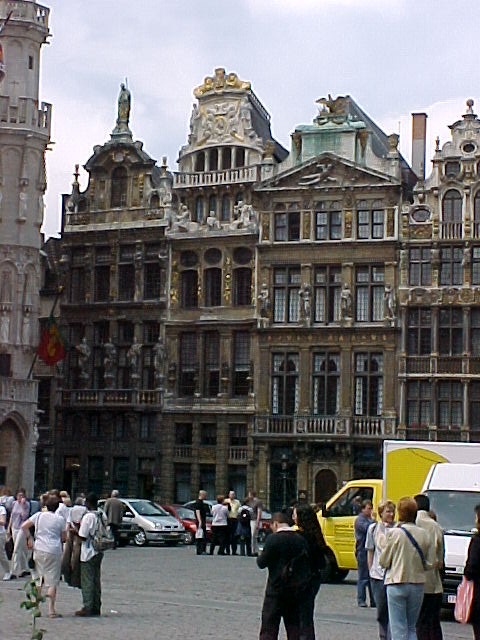 The elaborate guilds surrounding the Grand-Place.
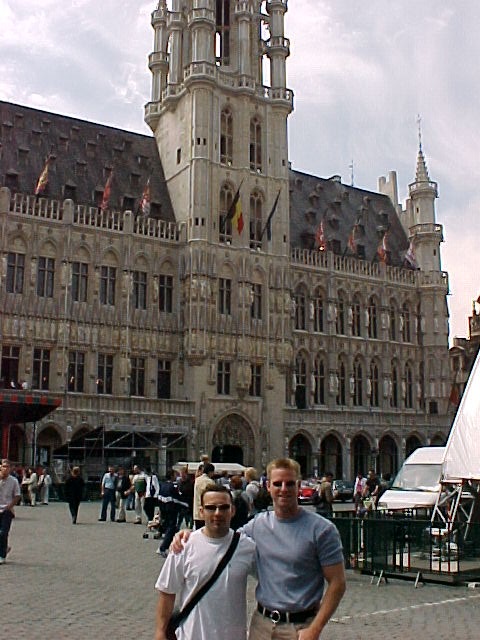 Alex and me in the Grand-Place.
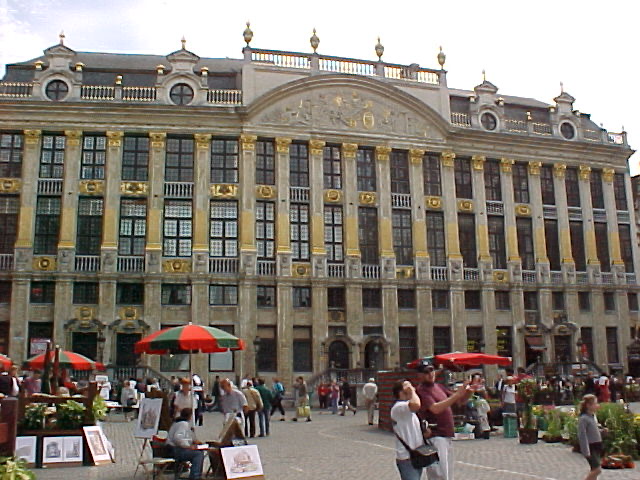 Gold, stone and centuries of history packed into every square
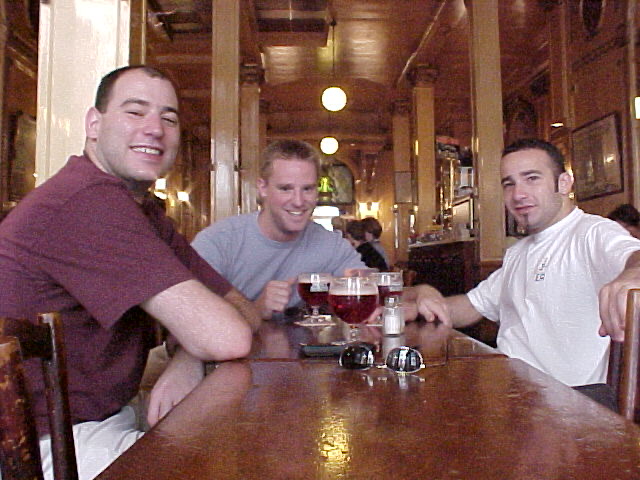 Patrick explaining the guilds over a breakfast? Beer
A City Rebuilt by Its Trades
There was another layer to the square that I hadn’t appreciated simply by looking at it. In 1695, French forces bombarded Brussels and destroyed most of the buildings surrounding the Grand Place. Apparently (Rhett would fill in these details later) the French army bombarded Brussels largely as a strategic diversion. European allied forces were besieging the French-held fortress of Namur, and France hoped that attacking Brussels, an important city then under Spanish and Netherlands control, would force the Allies to pull troops away from Namur. It didn’t work. Namur still fell, while Brussels suffered catastrophic destruction.
The guilds rebuilt quickly though, creating much of the extraordinary Baroque ensemble standing today.
So what initially looked like an impossibly intact piece of medieval Europe was actually something more interesting: a commercial city repeatedly rebuilding itself on top of its own history. That theme seemed to be everywhere in Brussels. Old structures weren’t sealed away from modern life. People worked in them, ate beside them, crossed through them and built the next version of Europe around them.
A Beer Made by a Place
Belgian beer was also beginning to make more sense to me as something larger than simply a national drink. Brussels and the surrounding Senne valley are famous for lambic. Lambic is a traditional Belgian beer associated especially with Brussels and the nearby Senne Valley. What makes it unusual is the fermentation: instead of adding a standard brewer’s yeast, traditional lambic is exposed to naturally occurring yeasts and microorganisms in the local environment, which ferment the beer spontaneously.
The local environment itself becomes part of the process.
Gueuze is produced by blending lambics of different ages and allowing them to ferment again in the bottle. In other words, this wasn’t simply beer made in Brussels. It was beer that, historically, depended upon Brussels.
We sampled it in the manner I generally sampled beer, by sharing one: it was still breakfast after all. Patrick also introduced us to a Belgian breakfast involving bread, radishes, green onions and various spreads. I no longer remember what the bread was called but I remember it being a long, seasoned fresh-baked cracker. Not my typical breakfast but it was both delicious and memorable.
Brussels, Century by Century
After breakfast, we I started walking. And kept walking. Brussels seemed to change centuries every few blocks.
Medieval commercial streets gave way to Gothic churches, fragments of old fortifications, formal gardens and monumental civic buildings, before depositing us back into narrow lanes filled with cafés and people going about an entirely modern European Saturday.
The old walls fascinated me. I had grown up in a part of America where towns simply spread outward until one eventually ran into another. European cities had spent centuries doing almost the opposite: clearly defining where the city ended and then building enormous walls to defend that boundary.
Yet in 2001, Europe was engaged in a remarkable experiment to make many of those boundaries matter less. That contrast was becoming increasingly hard to miss. We weren’t really touring individual attractions anymore. We were simply walking through the city and allowing layers of it to appear.
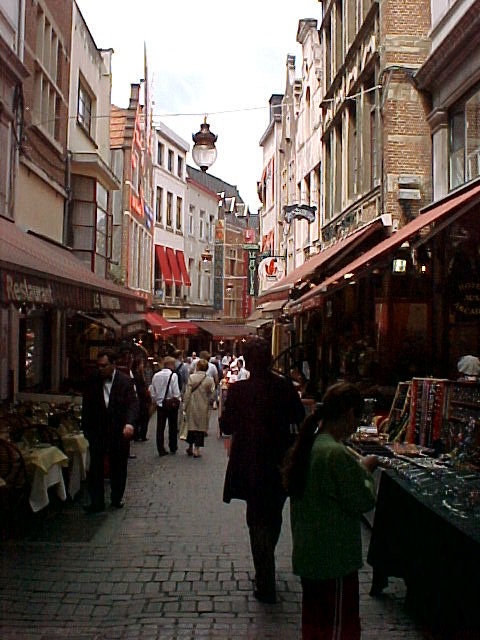 One of the narrow commercial streets near the center
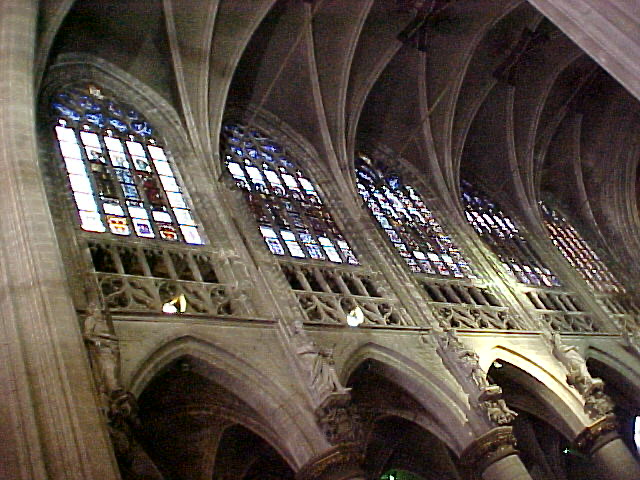 Inside one of the churches we wandered into along the way.
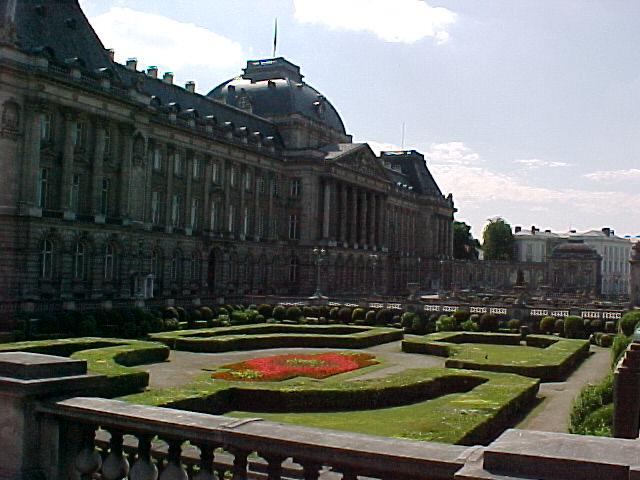 Belgian’s Congress
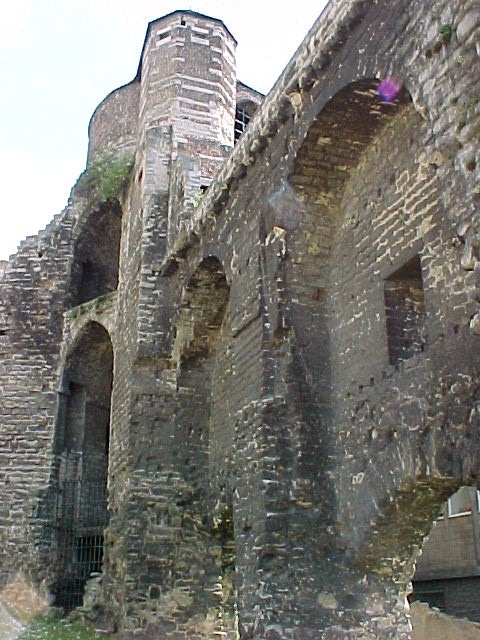 Remnants of the fortifications that once enclosed Brussels
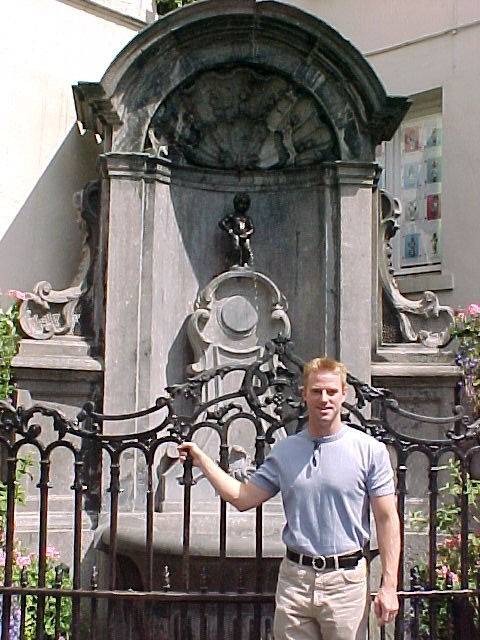 Me with Belgium’s most famous resident
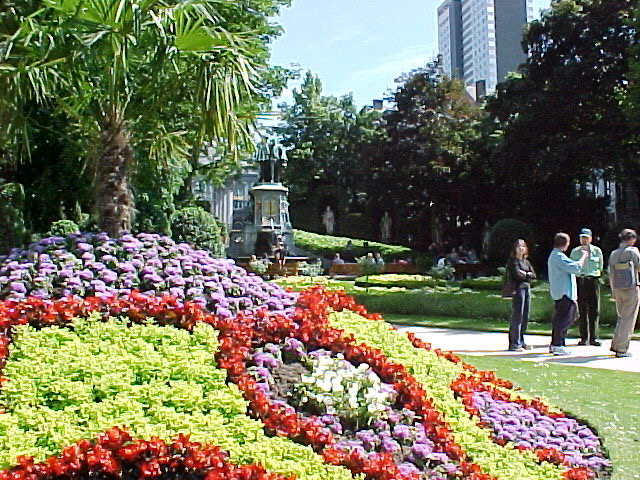 Formal gardens tucked into the center of Brussels
Belgium’s Most Famous Little Citizen
Eventually we arrived at one of Brussels’ less imposing monuments: Manneken Pis, a tiny bronze boy doing exactly what his name suggests, whose origins are considerably more practical than his enduring celebrity status would imply.
The fountain was part of Brussels’ public drinking-water system as far back as the 15th century, while the familiar bronze figure was created by Jérôme Duquesnoy the Elder in 1619; over the centuries he somehow evolved from municipal plumbing into an unofficial mascot of the city, surviving thefts, vandalism and even acquiring a wardrobe of more than a thousand costumes. A wonderfully Belgian transformation of something completely ordinary into a symbol of civic pride and self-deprecating humor.
There are several legends about why he is peeing. The most widely known has him extinguishing a fuse during a siege and thereby saving Brussels. That’s my favorite so I’ll report it here as fact.
After spending the morning surrounded by gilded guild houses, Gothic churches and centuries of European history, I rather liked that Brussels had chosen a two-foot-tall peeing child to represent its less serious side.
Money From the Future
Something else kept appearing throughout the trip that fascinated me almost as much as the old architecture.
The Euro.
Technically, the euro already existed. Belgium and ten other countries had adopted it in 1999 as their official currency for accounting and electronic transactions. But there were still no euro banknotes or coins in anyone’s wallet. Those would not arrive until January 1, 2002. So I was still carrying Belgian francs while increasingly seeing prices and financial information expressed in euros. It was an odd transitional moment: the new currency was present everywhere and nowhere at the same time.
Six months later, twelve European countries would put euro notes and coins into circulation simultaneously in what would become the world’s largest monetary changeover. Standing in Brussels made the whole project feel particularly tangible. Countries that had spent centuries building fortifications, fighting wars and guarding their borders were preparing to use the same money.
It felt like Europe was creating history in real time as we strolled through it.
Life in the Streets
We stopped periodically for coffee, food and shared beers, but the day was really about being out in the city. That was becoming one of the differences I noticed most.
Public life happened in public.
Cafés spilled onto sidewalks. Squares functioned as gathering places. Streets weren’t merely transportation corridors. People seemed to inhabit the city rather than retreat from it. Patrick wasn’t really giving us a sightseeing tour. He was showing us how he lived. That distinction mattered more than I realized at the time.
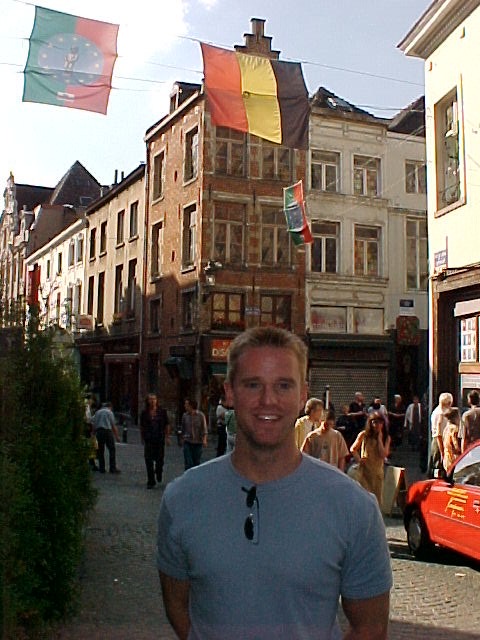 Back in the streets after a day of walking Brussels.
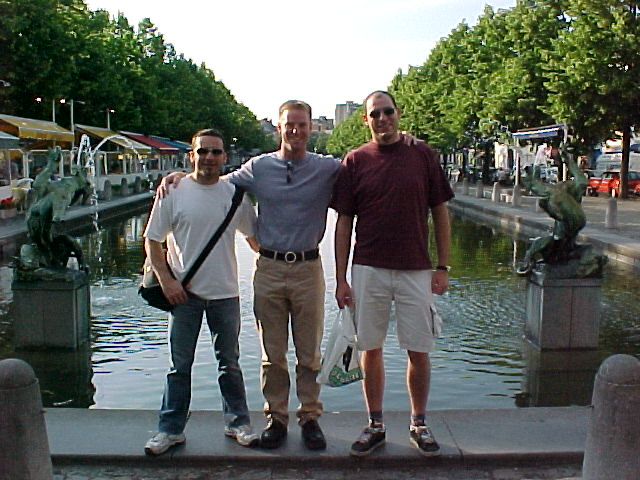 Alex, Patrick and me near the end of Saturday.
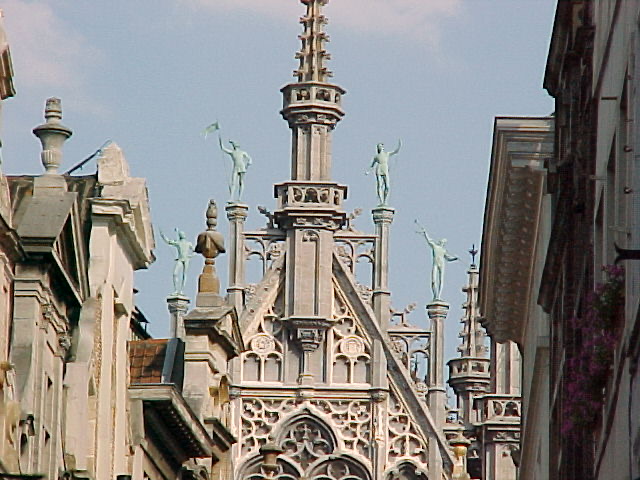 Another building that would have been the centerpiece of almost any American city and was simply part of the streetscape here.
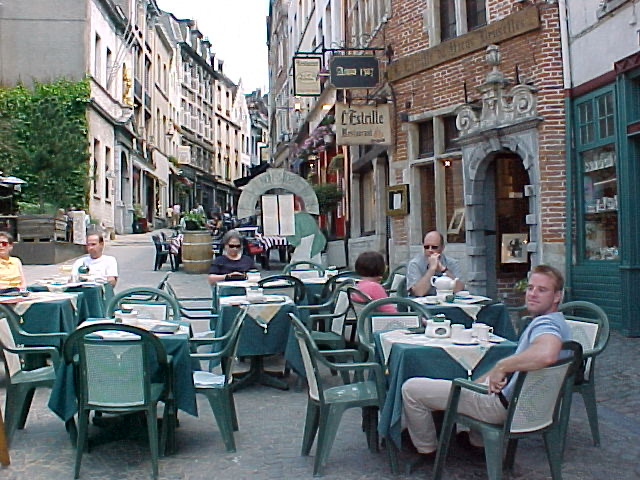 A necessary coffee stop.
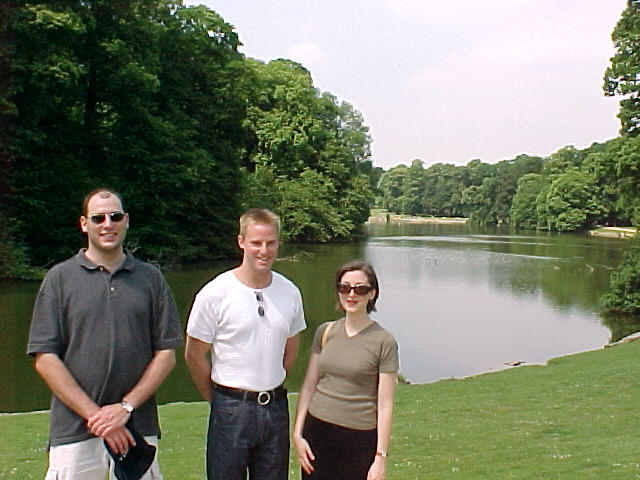 atrick, me and Stephanie on Sunday.
Sunday With Patrick
By Sunday, Patrick had moved us beyond the center of Brussels and into his actual life. We finally meet his wife, Stephanie, who was expecting their first child, and spent part of the day in a residential park.
Families were everywhere.
Children wandered alongside parents and siblings. People sat outside, walked, talked and treated the park as an extension of their neighborhood. It was ordinary. Which was exactly why it interested me. Anyone could visit the Grand-Place. This felt more like seeing how people actually lived.
Then Patrick took us to a car race.
A Different Definition of Winning
I thought I understood car racing: where I came from, the formula was horsepower, speed, noise and preferably enough of all three to be noticed several counties away, but the race Patrick took us to was the Shell Eco-marathon, a competition built around almost the opposite idea.
The modern event had begun in Europe in 1985, challenging student engineering teams to design and build vehicles capable of traveling the greatest distance using the least energy, and more than forty years later the competition still exists with increasingly sophisticated electric, hydrogen and other ultra-efficient vehicles.
Same basic machine, entirely different definition of winning.
Instead of asking how fast a car could go, these engineers were asking how efficiently it could move, which seemed an almost perfect metaphor for what I was beginning to notice about Europe: familiar ingredients—cities, cars, transportation, work and public space—organized around assumptions that could be remarkably different from the ones I had grown up with.
Coming from a culture much more familiar with NASCAR, I found the idea fascinating.
Twenty-five years later, with efficiency and electrification now at the center of the global auto industry, that little race in a Belgian park seems considerably less quirky, and considerably more prescient.
Back Through the Tunnel
On Sunday evening, Alex and I boarded the Eurostar back to London.
Now I had spent a weekend in Brussels walking among medieval guild houses, drinking a beer inseparable from the place where it evolved, moving through public spaces that had been occupied for centuries, carrying a national currency that was months away from disappearing, and watching engineers compete to see who could travel farthest using the least fuel.
Then we simply got back onto a train and went home to another country. That may have been the most remarkable part.
What had once sounded like an exotic European adventure was already becoming normal life. Outside the window, the French countryside rolled past as the sun began to set. A little later we disappeared beneath the English Channel and emerged back in England.
When I moved to London, I expected Europe to teach me about history. Florence certainly had. But Brussels taught me something I hadn’t anticipated. Europe wasn’t simply a collection of old places I could visit on weekends. It was a different way of arranging modern life, built around all that history and, in 2001, still actively reinventing itself.
I’d like to think I was becoming more European after one weekend. But more likely I was getting a sense of how to live more European.
And I like it.
Revisiting this post in 2026: Learning to Live European
Looking back, what strikes me most is how quickly Europe was becoming normal to me.
Only a few months earlier, the idea of taking a train under the English Channel for a weekend in Belgium would have sounded impossibly exotic; by June 2001, I was simply leaving work, packing a bag, meeting a friend in another country and coming home late Sunday night.
I remember my first Eurostar ride, the Grand Place appearing almost impossibly ornate around a spectacular hotel room balcony, Patrick explaining the guilds over breakfast, wandering through Brussels without much of a plan, and carrying Belgian francs while signs quietly advertised the currency that would replace them several months later.
I also remember that strange little car race in the park.
But the most important part of Brussels wasn’t really the architecture, the beer, the euro or even disappearing beneath the Channel.
Patrick let me briefly experience his city as someone who lived there rather than someone who had arrived with a checklist: cafés were extensions of the street, parks were extensions of neighborhoods, centuries-old buildings remained part of everyday life, and crossing an international border could be as routine as catching a train.
Brussels began showing me how Europeans had built modern life around ancient architecture, customs, and culture.
Twenty-five years later, I think that was one of the great gifts of living in London: I stopped thinking of Europe as a collection of places I wanted to see and started understanding it as a collection of different ways people had learned to live.
And somewhere underneath the English Channel on the ride home, I was becoming a little more European in my thinking.