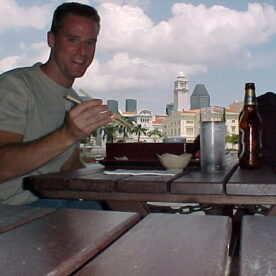
This is my first trip since September 11.
It has been less than two weeks, and although life in London is beginning to move again, nothing quite feels normal. The merger at work is back on and moving quickly, military action seems increasingly likely, and airlines are still operating in a world of uncertainty. With a long weekend available, I would normally consider flying home to Washington, but I cannot risk crossing the Atlantic and then discovering that another disruption prevents me from getting back to work in London.
So I am restricting myself to Europe and places from which, in the worst case, I could jump on a ferry back to London if it came to it.
Prague seems like a good place to start traveling again.
There is something fitting about coming here now. Prague is a city accustomed to uncertainty, invasion and abrupt changes in the political order. The Communist government of Czechoslovakia collapsed only twelve years ago in the Velvet Revolution, the Czech Republic itself is only eight years old — way younger than even me — and the country is now trying to complete an extraordinary transformation from a centrally planned Communist state into a Western market democracy. It has already joined NATO and is negotiating its way toward membership in the European Union.
Without Rhett along as my trusted European history professor, my Lonely Planet Pocket Guide fills in the gaps, explaining not just what I am looking at but why it matters. I am increasingly finding that the difference between seeing an old building and understanding one is knowing why somebody bothered to build it in the first place.
There will be plenty of culture tomorrow, but the first night we set out to grab a nightcap before retiring in the luxurious Renaissance Prague hotel. I wasn’t going to miss out on a single amenity I was entitled to having recently acquired lifetime platinum status with Marriott hotels.
Breakfast in Bed and a Thousand Years of Power
Saturday begins with one of my favorite vacation traditions: breakfast in bed. It accomplishes two things simultaneously. First, breakfast arrives without requiring clothing. Second, and not least, the knock on the door forces me to get up and out of bed. I consider this excellent hotel management.
From there we board one of Prague’s street trams and climb toward Prague Castle.
Prague Castle is not really a castle in the simple fortress-and-turrets sense. It is a collection of palaces, churches, courtyards and fortifications that has accumulated over more than a thousand years as successive rulers reshaped the same hilltop to reflect their own ideas of power. The first castle was established here around 880, and the complex eventually became the seat of Bohemian princes, Czech kings, Holy Roman emperors and, now, the president of the Czech Republic.
From below, the architectural layers are obvious.
The ceremonial entrance is almost comically unsubtle. Giant figures fight to the death above the gates. A gold crown adorns an intricate spiral lattice work ornamentation. Gates nested within gates. Apparently, each time Prague was conquered the first thing the new regime did was add another layer of either security or ornamentation.
Then St. Vitus Cathedral appears.
What I would once have dismissed simply as “another old European church” turns out to be something much more interesting. Construction of the Gothic cathedral began in the 14th century under Charles IV, who intended it as the coronation church of the Bohemian kings, a physical expression of Prague’s importance within the Roman Empire. The French-trained architect Matthias of Arras began the design, followed by Peter Parler, whose work helped give Central European Gothic architecture a language of its own.
And then history intervened.
Wars, political upheaval and changing fortunes repeatedly stopped construction. The cathedral that begins in the Middle Ages is not actually completed until 1929. What looks like a perfectly unified Gothic monument is therefore partly medieval and partly the work of mid-century architects deliberately completing a vision begun six hundred years earlier.
That idea lands differently this weekend.
For most of my travels through Europe, churches have represented art, architecture and an almost unimaginable amount of labor. Eleven days after watching airplanes destroy buildings at home, I find myself thinking more about why people build monuments meant to outlive them. These structures have survived plagues, wars, occupations, collapsing dynasties and political systems that once seemed permanent. There is something reassuring in that.
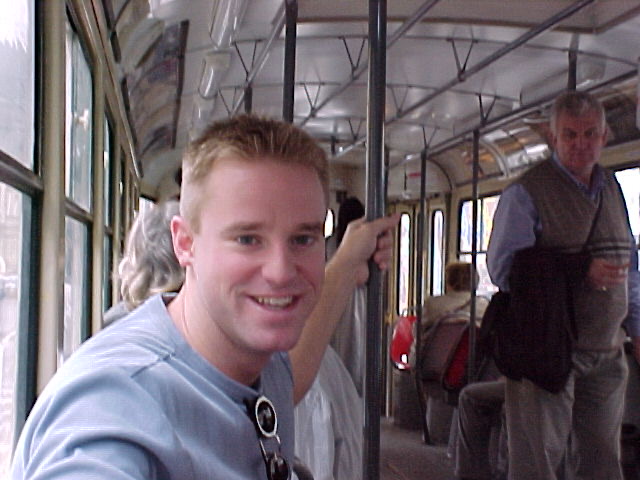 Prague’s trams, carrying me uphill toward the castle and considerably more history than I can absorb in one morning.
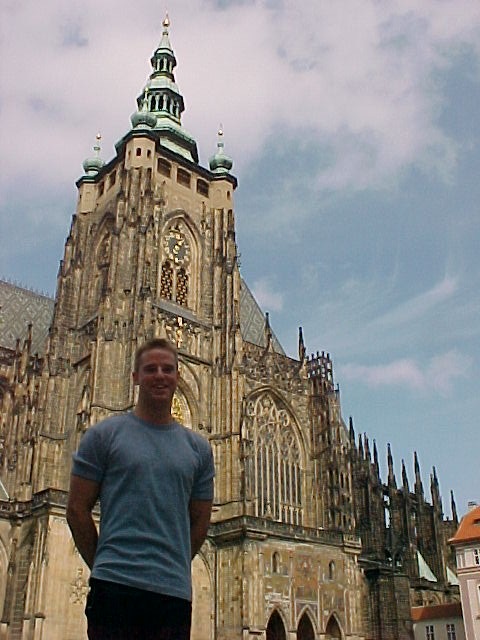 St. Vitus Cathedral inside Prague Castle — less a single building than six centuries of architecture reaching upward.
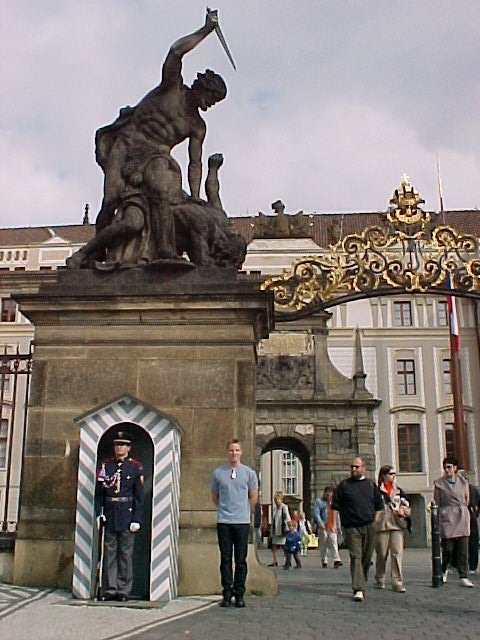 The ceremonial entrance to Prague Castle, guarded by soldiers below and Platzer’s wrestling giants above.
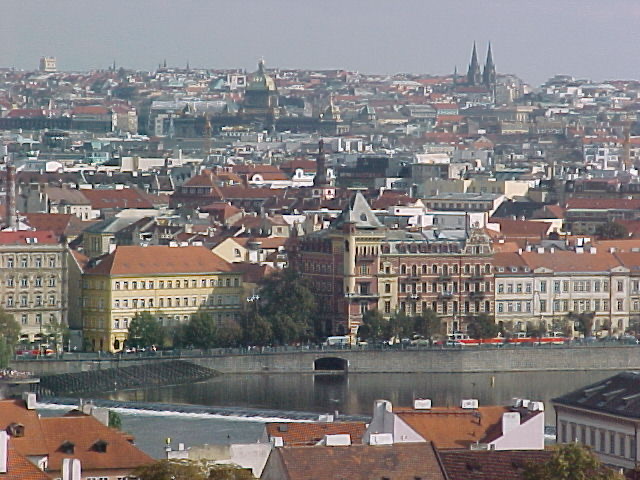 From the castle terraces, Prague spreads out below in red tile, towers and the Vltava River.
A Painting from a Changing East
After leaving the castle, I wander through an area filled with galleries showing Eastern European artists. Prague’s art market feels like another window into the enormous transition taking place around it. For four decades, artists worked within a Communist system that both supported cultural institutions and imposed political limits on what could be expressed. Now those artists and galleries are suddenly operating in an international market.
I buy an unfinished painting of abstract sunflowers by an Eastern European artist whose other work, according to the gallery owner, tends toward loneliness and despair. He believes the flowers were eventually supposed to wilt, but for whatever reason the artist stopped before finishing them.
I rather like them alive. The painting will eventually hang in my dining room, the only despair over my cooking.
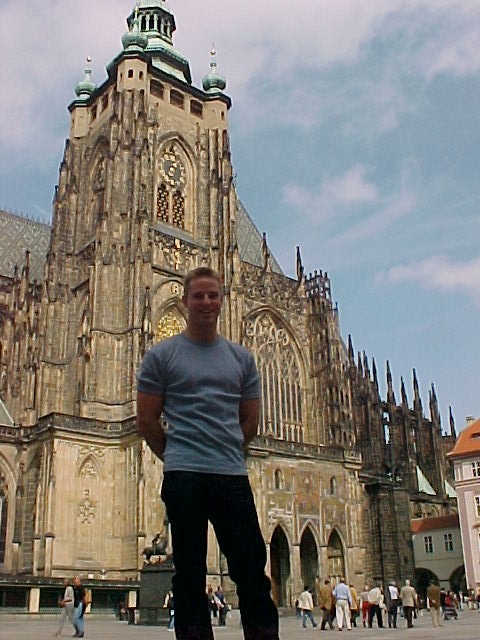 Standing in front of St. Vitus, where Czech kings were crowned and centuries of rulers used architecture to connect political power with the church.
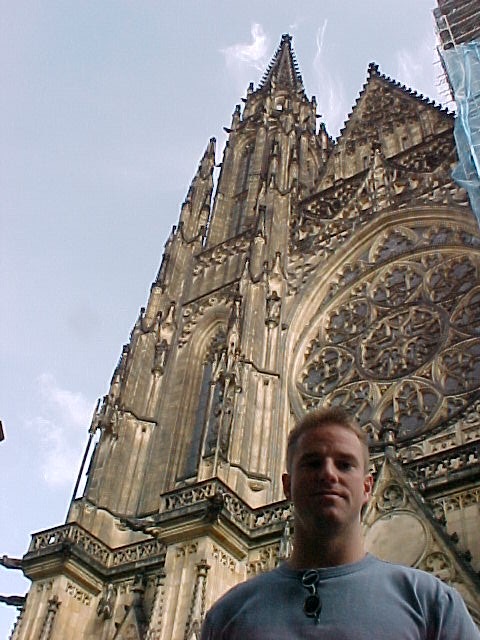 The Gothic stonework of St. Vitus — designed to pull the eye upward and make human scale seem suddenly rather insignificant.
A Tower with More Than One Purpose
Prague rewards anyone willing to climb stairs, so I find myself inside the St. Nicholas Bell Tower in Malá Strana, winding upward through old timber and masonry. There are 215 steps to the viewing gallery, which is apparently the historical price of obtaining a good photograph.
The tower beside St. Nicholas Church is an interesting architectural deception. Although it looks like part of the church, it belongs to the city rather than the church and historically served as a municipal bell and fire-watch tower.
The Lonely Planet guide supplies the detail that makes the tower especially fascinating. During the Communist period, Czechoslovakia’s State Security service used the upper levels as an observation post, watching the Western embassies scattered through Malá Strana below. A tower built to spot fires eventually becomes a place for spotting diplomats.
Will they ever stop finding new ways of spying on people?
From the gallery, the city becomes a study in rooftops and political geography. The grand churches, diplomatic compounds, Communist-era additions and older neighborhoods all occupy the same landscape. It is amazing if you think about it. I’m standing inside a beautiful 18th-century tower and learning that only a little more than a decade ago someone may have occupied the same perch with binoculars, recording who entered and left the embassies below.
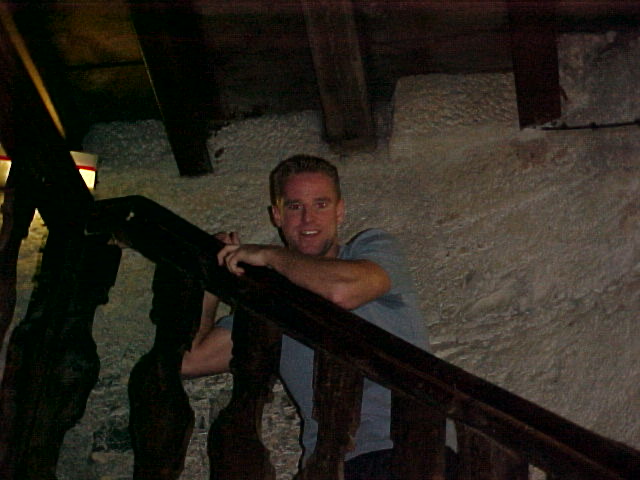 Climbing the wooden interior of the St. Nicholas Bell Tower in Malá Strana.
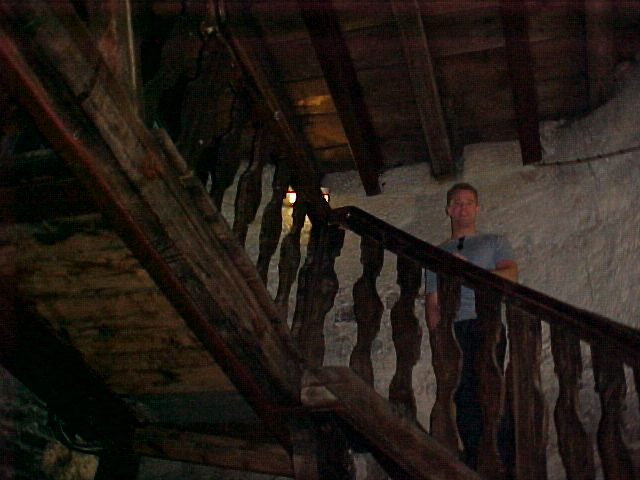 Still climbing. Medieval and Baroque sightseeing apparently predates elevators.
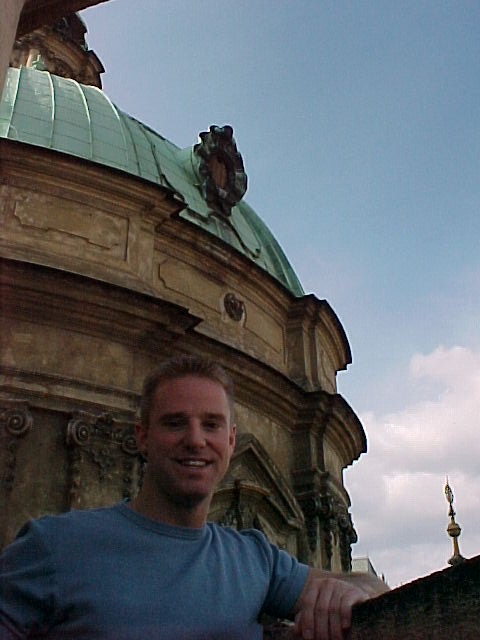 Beside the great copper dome of St. Nicholas, one of the defining Baroque landmarks of Malá Strana.
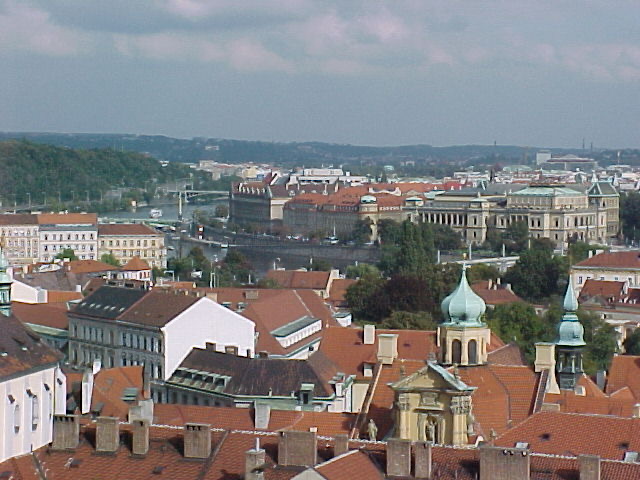 Looking across the tiled roofs of Malá Strana toward the Vltava from the St. Nicholas Bell Tower.
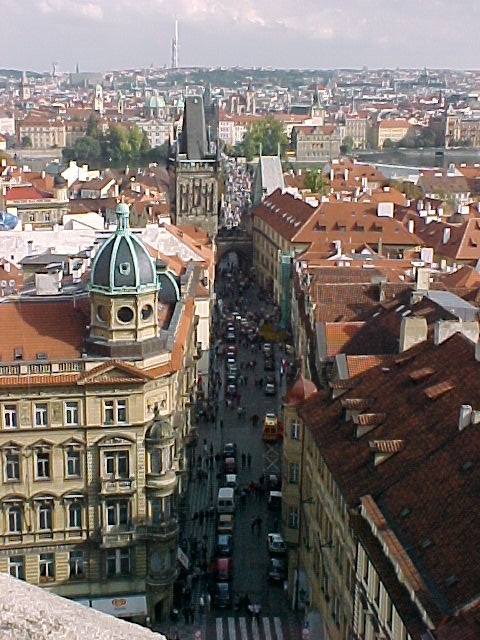 The view east toward the river and Old Town, with the narrow streets of Malá Strana running toward Charles Bridge.
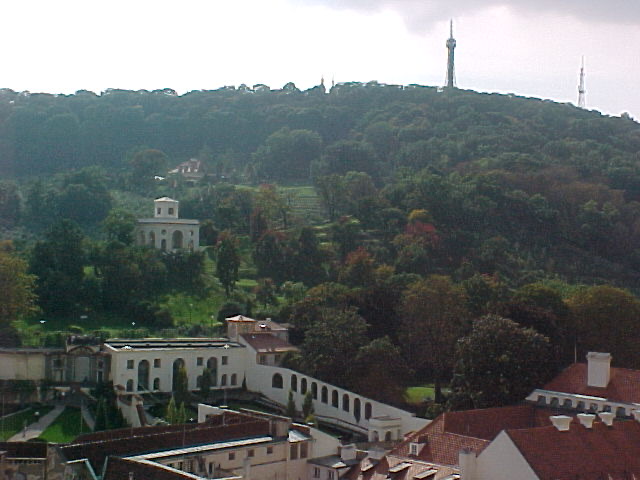 Looking toward the wooded slopes of Petřín Hill from the bell tower.
Music in a Very Old Room
Saturday evening brings me back uphill for something Prague does exceptionally well: classical music.
The concert is by Solisti di Praga at St. George’s Basilica inside Prague Castle, with a program moving through Vivaldi, Handel, Schubert and Dvořák. To my amusement, the concert hall is older than every piece of music being performed inside it — and even that understates its age. St. George’s was founded in 920, then rebuilt after a fire into the Romanesque basilica that largely survives today, with its Baroque façade added centuries later. Inside, the architecture is remarkably restrained: thick stone walls, rounded arches and little ornamentation compared with the Gothic spectacle of St. Vitus next door. The room seems designed to let the music fill the space.
And tonight I need that.
It is impossible to sit through The Four Seasons, Schubert and Dvořák this particular week without my thoughts periodically drifting home. The images from September 11 are still replaying everywhere. Military action is discussed daily, airports remain unsettled, and nobody seems certain what the next few months will look like.
Yet here we are, listening to musicians perform works written centuries ago inside a church that has survived dynasties, religious wars, foreign armies, Nazi occupation and four decades of Communist rule. The musicians keep playing, just as people have continued gathering inside these walls through one upheaval after another.
The performance does not make the world feel less uncertain. It makes uncertainty feel less unprecedented.
Afterward I walk back toward Old Town and the Renaissance Hotel, stopping for dinner at Kolkovna v Kolkovně, a new restaurant that seems perfectly suited to the Prague I am beginning to understand. It opened this year as the first Pilsner Urquell Original Restaurant, taking the traditions of the Czech beer hall and recasting them for a more modern Prague. Even the building carries another layer of history: its restored rooms once belonged to a customs operation where securities and duty stamps were printed.
The menu does something similar, taking Czech cooking seriously without treating it as a museum piece. I settle into game, fruit sauces and rich stews alongside a properly poured Pilsner Urquell — substantial food that makes considerably more sense after a day spent climbing castle hills and bell towers.
There’s a nice symmetry to ending the day this way. I have spent it inside buildings carrying almost a thousand years of Prague’s past, and I finish it in a restaurant that is very much about what Prague is trying to become.
Charles Bridge in the Rain
Sunday morning begins exactly as Saturday did: breakfast in bed. Life’s little luxuries don’t require second-guessing. Then it continues with one of Lonely Planet’s recommended self-guided walking tours. And the first stop? Charles Bridge of course.
The weather has turned colder and rainy, which suits Prague remarkably well. I head toward Charles Bridge before the city fully wakes, the gray sky softening the skyline while the Vltava moves quietly below.
One of Prague’s most recognizable landmarks, Charles Bridge was begun under Charles IV in the 14th century after flooding destroyed the earlier Judith Bridge. Built from sandstone and associated with the workshop of Peter Parler, it became the great ceremonial link between Old Town and Prague Castle. The statues that now line the bridge came later, mostly during the Baroque period, turning a medieval crossing into something closer to an open-air gallery.
Millions of people have crossed here before me: kings following coronation routes, merchants hauling goods, soldiers, revolutionaries, occupying armies, and generations of Prague residents simply trying to get from one side of the river to the other. This morning, though, there is almost no one.
I’m glad I woke early enough to have the bridge nearly to myself, standing in the rain on a piece of Prague that has carried people through centuries of upheaval and ordinary life alike.
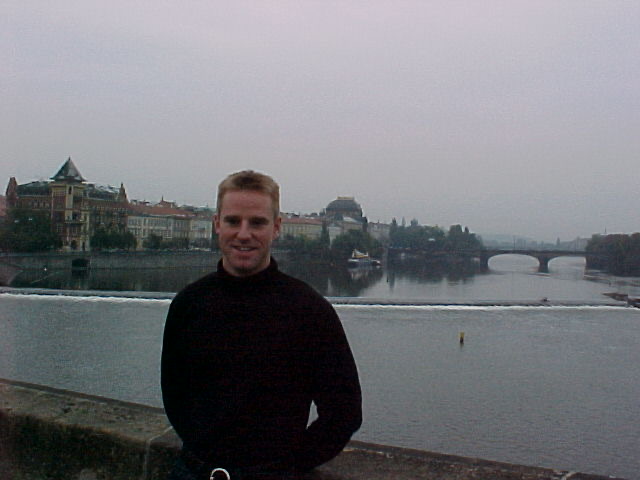 Along the Vltava on a cool, rainy Sunday morning, with Prague disappearing into the gray behind me.
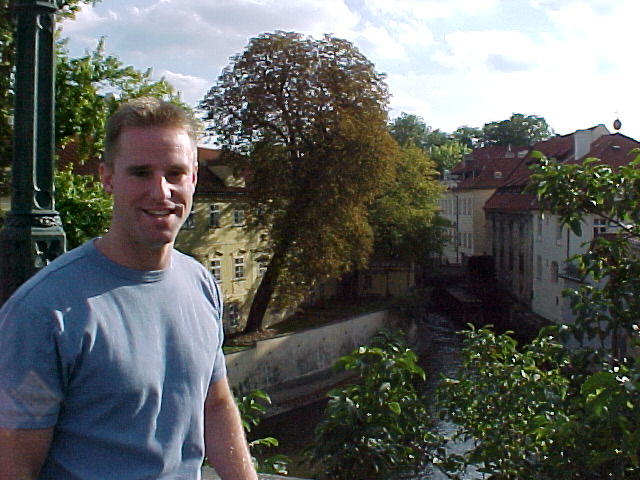 Looking down toward the waterways and old mill district beside Charles Bridge.
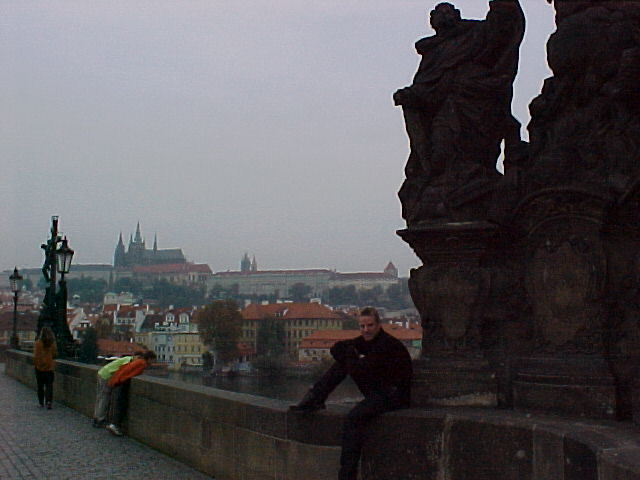 On Charles Bridge beneath the Baroque saints, looking toward the city through the Sunday rain.
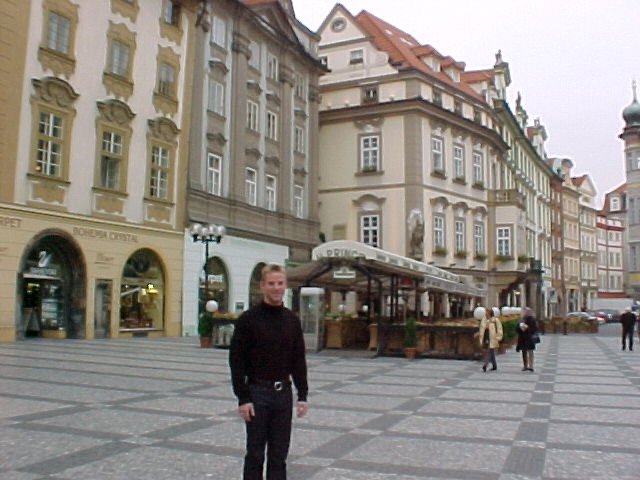 Malé náměstí — Little Square — tucked just beside the much larger Old Town Square.
Old Town, One Layer at a Time
The walk then takes me back into Old Town, Prague, which becomes more intimate. The huge castle disappears behind the roofs and the city turns into small squares connected by twisting lanes. Following the fold out map, I wind my way to Malé náměstí, the “Little Square.”
In the center of Malé náměstí is a wonderful survival from an earlier Prague: an old public well protected by an elaborate wrought-iron grille dating from the 16th century. The surrounding buildings have been repeatedly remodeled in Renaissance, Baroque, Rococo and later styles, but the square’s basic function is much older, serving for centuries as a marketplace and gathering place in the heart of the medieval city.
Naturally, I have to determine whether the well still works. And it does.
Josefov: A City That Nearly Disappeared
The next segment of the walk takes me on an exploration of Josefov, Prague’s historic Jewish Quarter.
Jewish life in Prague reaches back roughly a thousand years. By the Middle Ages, a distinct Jewish neighborhood had developed here with its own synagogues, schools and community institutions, living through alternating periods of prosperity, protection, restriction and violent persecution. Prague eventually became one of Central Europe’s most important centers of Jewish learning and culture.
The monuments that survive make the history unusually tangible. The Old-New Synagogue was built in the 13th century and remains the oldest functioning synagogue in Europe. The neighborhood itself, however, is not a perfectly preserved medieval museum. Much of old Josefov was demolished during a huge urban renewal project around the turn of the 20th century as Prague attempted to replace crowded medieval streets with the broad avenues and grand apartment buildings of a modern European capital. The synagogues and cemetery that remain are fragments of a much larger world that largely vanished.
Then came a far greater destruction. The Jewish community of Bohemia and Moravia was devastated during the Holocaust. The Pinkas Synagogue now memorializes roughly 80,000 Czech and Moravian Jewish victims, their names covering its walls. Walking through Josefov less than two weeks after a mass-casualty attack at home makes the scale of that history especially difficult to treat as simply another sightseeing stop.
This is a neighborhood built around survival and memory.
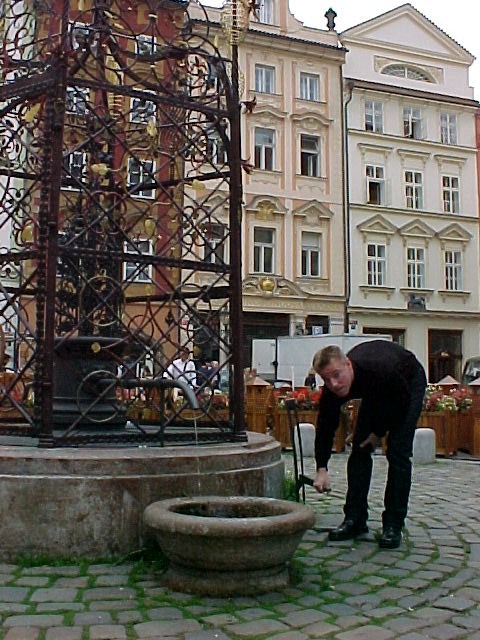 Testing the old well in Malé náměstí. Hundreds of years of history, reduced to the important question: does water still come out?
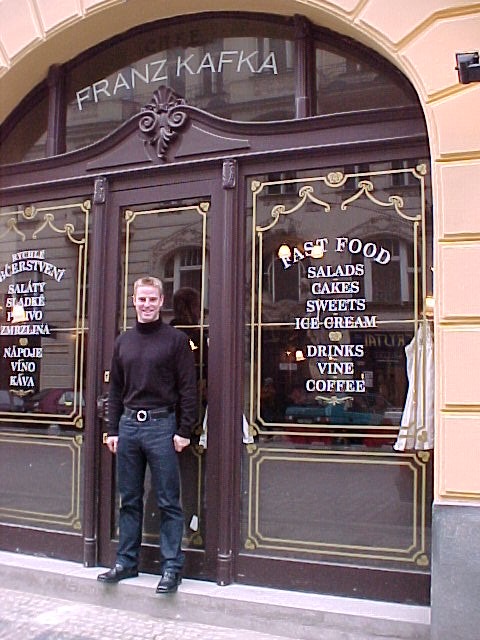 Kafka has become sufficiently famous in his hometown to have cafés trading on the name. Whether he ever ate here is considerably less certain.
Kafka’s Prague
Josefov also leads me toward one of my favorite writers, Franz Kafka.
Kafka was born in Prague in 1883 into a German-speaking Jewish family and spent almost his entire life within a remarkably small part of the historic center. His family moved repeatedly, but most of their homes remained clustered around Old Town Square and the former Jewish quarter. Prague was not merely a backdrop to his writing; its overlapping Czech, German, and Jewish identities helped create the cultural tension in which he lived.
His stories create worlds in which individuals confront systems whose rules they cannot understand, authorities they cannot reach and bureaucracies that seem simultaneously absurd and terrifying. It is easy to see why we now have the word Kafkaesque.
The great irony is that Kafka dies in 1924, never experiencing Communist Czechoslovakia at all. And yet his writing later seems almost perfectly suited to describing some of its machinery. Communist critics initially dismiss his work as decadent and ideologically suspect, and for years Kafka is difficult to publish openly in his own country. Then, in 1963, a conference devoted to Kafka at Liblice Castle becomes part of a broader cultural thaw. Debating whether Kafka may be read also becomes a way of debating alienation, bureaucracy and Stalinism itself. That intellectual opening helps set the cultural atmosphere preceding the Prague Spring of 1968.
After Soviet-led forces crush the Prague Spring, Kafka again becomes problematic. His strange bureaucratic nightmares apparently cut a little too close to reality.
That history makes his presence everywhere in Prague today especially interesting. Eleven years after the Velvet Revolution, the writer once marginalized by the Communist state has become one of the city’s most recognizable cultural figures. Kafka has gone from troublesome writer to literary icon to, judging from the storefront behind me, marketable brand.
There is definitely something appropriately Kafkaesque about that too.
Between East and West
The more I walk, the less useful the easy description of Prague as simply “Eastern Europe” becomes.
The Communist system is gone, but four decades of central planning do not disappear with a revolution. Since 1989, the Czech Republic has been liberalizing prices, privatizing state businesses, rebuilding financial and legal institutions and opening the country to foreign investment. The reforms have pulled it rapidly back into the European economy, but they have also exposed obsolete infrastructure and industries that now have to compete internationally. The result is a city where restoration, new investment and lingering remnants of the old system exist in one space.
This is not a city that somehow failed to keep up with cities to the west. It spent much of the 20th century living through the collapse of an empire, Nazi occupation, Communist dictatorship, Soviet intervention and then another wholesale reinvention of its political and economic system.
Now it is trying to reconnect itself with Western European neighbors at lightening speed.
Maybe the lesson of Prague is patience, the kind required to rebuild an society and decide what parts of the past deserve to be preserved while almost everything around you is changing.
For a first trip back into the world after September 11, that seems like a useful idea to take home.
Revisiting This Post in 2026: Prague in Transition
Twenty-five years later, the part of my original account that stands out most is how quickly I judged Prague against Western Europe. I saw the scars of Communism, the uneven development and some of the stranger edges of a society rebuilding itself and interpreted them largely as evidence that Prague had “catching up” to do.
The Czech Republic had emerged from Communist rule only twelve years before I arrived. The reforms I witnessed in rpogress in 2001 — privatization, foreign investment, new institutions and integration with Western Europe — continued, and the country joined the European Union on May 1, 2004. The Prague I was walking through was quite literally between political and economic systems.
What I remember most clearly now is the rain on Charles Bridge. It is climbing a tower that had watched both fires and foreign diplomats. It is Kafka’s old neighborhood and the extraordinary survival of Josefov. It is sitting inside a Romanesque basilica listening to Vivaldi while the world outside felt suddenly much less stable than it had two weeks earlier.
September 11 changed the context of this trip in a way I did not fully capture at the time. Prague was my first tentative step back into traveling, and I happened to choose a city that had spent centuries demonstrating that uncertainty, disruption and reinvention are not interruptions to history.
They are history.
And one conclusion from 2001 requires absolutely no revision after twenty-five years: breakfast in bed remains the correct way to begin a vacation.